




The first signs, how long it lasts, what a blood test can and can’t tell you, and what truly brings relief.
A member of the team calls you back. Free, no commitment.
- Ages 45 to 50The most common age of onset
- 4 years on averageFrom two to eight years, depending on the woman
- Age 51The average age of menopause in France
- 12 months without a periodTo confirm menopause
Key points
- Perimenopause is the transition that precedes menopause. It most often begins between ages 45 and 50 and lasts four years on average.
- Its first signs are irregular cycles, followed by hot flashes, night sweats, sleep problems and mood swings.
- After 45, the diagnosis rests on symptoms: hormones fluctuate too much for a single measurement to settle it. A blood panel mainly serves to rule out another cause, such as the thyroid or an iron deficiency.
- Menopausal hormone therapy is the most effective treatment for hot flashes. It is a decision to discuss with a doctor, based on symptoms and medical history.
- After menopause, cardiovascular risk and bone loss increase: this is the time to measure cholesterol, blood glucose, blood pressure and vitamin D.
Updated November 12, 2026 · Sources
What is perimenopause?
Perimenopause is the transition period that precedes menopause. The ovaries work irregularly, hormones fluctuate, cycles become erratic and the first symptoms appear. It ends one year after the final period.
Menopause is a date: that of the final period, which can only be confirmed after twelve months without bleeding. In France, it occurs at around age 51 on average. Perimenopause is everything that happens before, and during the year that follows.
“Premenopause” and “perimenopause” are often used interchangeably. The second is more precise: it refers to the phase when cycles and hormones begin to change, not the whole of life before menopause.
During this transition, hormones don’t decline in a straight line. Progesterone drops first. Estrogen goes on a roller coaster: sometimes very high, sometimes crashing, from one month to the next. It is these swings, more than the decline itself, that explain symptoms that can be puzzling.
At what age does perimenopause start, and how long does it last?
Perimenopause most often begins between ages 45 and 50, sometimes as early as the early forties. It lasts four years on average, with wide variation, from two to eight years.
The age of onset depends partly on heredity: the age at which your mother reached menopause gives an indication. Smoking brings it forward by one to two years on average.
Before age 40, periods stopping is not ordinary menopause. It is called premature ovarian insufficiency. It affects about one woman in a hundred and calls for a specialized workup and follow-up. Cycles that become less frequent or stop before 40 therefore always warrant a medical consultation.
What are the symptoms of perimenopause?
The first sign is a change in cycles: shorter, longer, heavier or skipped. Then come hot flashes, night sweats, sleep problems, mood swings, fatigue and vaginal dryness.
| Area | Common signs | Good to know |
|---|---|---|
| Cycles | Periods closer together then further apart, heavier or lighter, skipped cycles | Very heavy bleeding, or bleeding between periods or after sex, should be reported to your doctor |
| Heat | Hot flashes, night sweats | The most typical symptoms; they affect a majority of women |
| Sleep | Waking at night, trouble falling back asleep | Often linked to sweats, but not only |
| Mood and mind | Irritability, anxiety, low mood, memory lapses, trouble concentrating | “Brain fog” is common and most often temporary |
| Body | Fatigue, joint pain, weight gain around the waist, tender breasts, migraines | Not very specific: other causes need to be ruled out |
| Intimate health | Vaginal dryness, lower desire, urinary discomfort | These signs tend to last; they respond well to treatment |
Not every woman feels everything, or with the same intensity. Some go through this period with almost no symptoms. Others see their sleep, their work and their relationship seriously affected. In both cases it is normal, and in the second, it can be treated.
Do you need a hormone panel to diagnose perimenopause?
After 45, no: the diagnosis rests on symptoms and cycles. Hormones fluctuate so much that a single measurement can be normal one month and abnormal the next. A hormone panel is useful before 45, when there is doubt, or to rule out another cause.
| Test | What it tells you | Limitation |
|---|---|---|
| FSH | High when the ovaries respond less | Varies widely from one cycle to the next during the transition |
| Estradiol | The main estrogen | Can be low, normal or high depending on the day |
| Progesterone | Shows whether ovulation has occurred | Read according to the point in the cycle |
| TSH | Rules out a thyroid disorder | Its symptoms resemble those of perimenopause |
| Ferritin and CBC | Screen for an iron deficiency linked to heavy periods | A common and correctable cause of fatigue |
| Lipid panel, blood glucose | Track cardiovascular risk, which rises after menopause | To be repeated over time |
| Vitamin D | Contributes to bone health | Bone becomes more fragile in the years after menopause |
In other words, the blood test is not so much about “proving” perimenopause as about not missing something else: a thyroid problem, an iron deficiency, prediabetes. It also sets a baseline for the heart and metabolism, just as the protection of estrogen fades.
Our women’s health check-up page details the biomarkers specific to women, and our guide to reading your blood test explains every line of the report.
Who interprets your results? Your doctors, over the long term.
Your results are read by a doctor registered with the French Medical Council, who follows you from one check-up to the next. Your doctor can prescribe additional tests and refer you to the right specialist if a result calls for it.
Around your doctor, a nutritionist and a fitness and wellness coach turn the recommendations into concrete actions. If your doctor were to leave, a colleague takes over your file with your full history. Our medical standards


How can you relieve the symptoms of perimenopause?
Through lifestyle first, and through treatment when symptoms get in the way. Menopausal hormone therapy is the most effective treatment for hot flashes. It is a decision to discuss with a doctor, based on your symptoms, your age and your medical history.
What is up to you
- Physical activity, especially strength training: it protects bone, muscle, the heart and sleep.
- Sleep: a cool bedroom, regular hours, little alcohol in the evening, since it worsens night sweats.
- Diet: enough protein and calcium, fewer fast sugars. The abdominal weight gain of this period is due to both hormones and muscle loss.
- Smoking: quitting reduces hot flashes and cardiovascular risk.
Treatments
Menopausal hormone therapy combines estrogen, most often through the skin, with progesterone when the uterus is in place. It relieves hot flashes, sweats, sleep problems and vaginal dryness, and protects bone. It has contraindications, including a history of breast cancer or blood clots in the veins. Its benefit-risk balance is most favorable when it is started within ten years after menopause. The decision is individual and is reassessed every year.
Other options exist: local treatments for vaginal dryness, non-hormonal medications for hot flashes, behavioral therapies for sleep. Talk to your primary care doctor, your gynecologist or your midwife.
What about contraception?
Pregnancy remains possible until menopause is confirmed. Contraception continues until one year after the final period after age 50, and two years before age 50.
How do you track a hormonal transition?
Perimenopause stretches over years and is hard to read from a single measurement. Ikare’s follow-up is designed for that timescale, with repeated measurement.
The blood draw
The kit arrives at your home and the nurse draws your blood in the morning, at home or at the office, which limits variations linked to the time of day.
The results consultation
Your dedicated doctor goes over your hormones, your iron, your thyroid and your actual symptoms on a video call, about a month later.
Follow-up over the months
The plan is adjusted every month: sleep, activity, diet. The medical team answers by message between check-ins.
The six-month check
A second blood test, at home, shows whether the tracked values are moving in the expected direction.
The twelve-month review
The tests are repeated and reviewed against the first ones, with the same dedicated doctor.
A member of the team calls you back to talk about the hormone panel. Free, no commitment.
Why keep an eye on your heart and bones at this time?
Because estrogen was protecting the arteries and the skeleton. After menopause, LDL cholesterol rises, fat shifts toward the abdomen, blood pressure increases and bone loses density. These changes are silent, and they can be measured.
- The heart: cardiovascular disease is the leading cause of death in women. The risk increases in the years after menopause. A lipid panel, a blood glucose test and a blood pressure reading give the baseline.
- Bone: bone loss speeds up in the first few years. Weight-bearing physical activity, calcium intake and vitamin D slow it down. A bone density scan may be considered depending on risk factors.
- Metabolism: insulin sensitivity decreases. Fasting blood glucose and HbA1c help detect prediabetes.
- Muscle: muscle mass declines faster. Grip strength is a good reflection of it.
This is the right time to measure, precisely because everything is shifting. And to measure again six months or a year later.
How does Ikare support you through perimenopause?
For women, the Ikare check-up includes estradiol, progesterone, FSH, LH, the thyroid and an iron panel, along with biomarkers for the heart, metabolism and nutrition. A doctor reads them alongside your symptoms and follows you for twelve months.
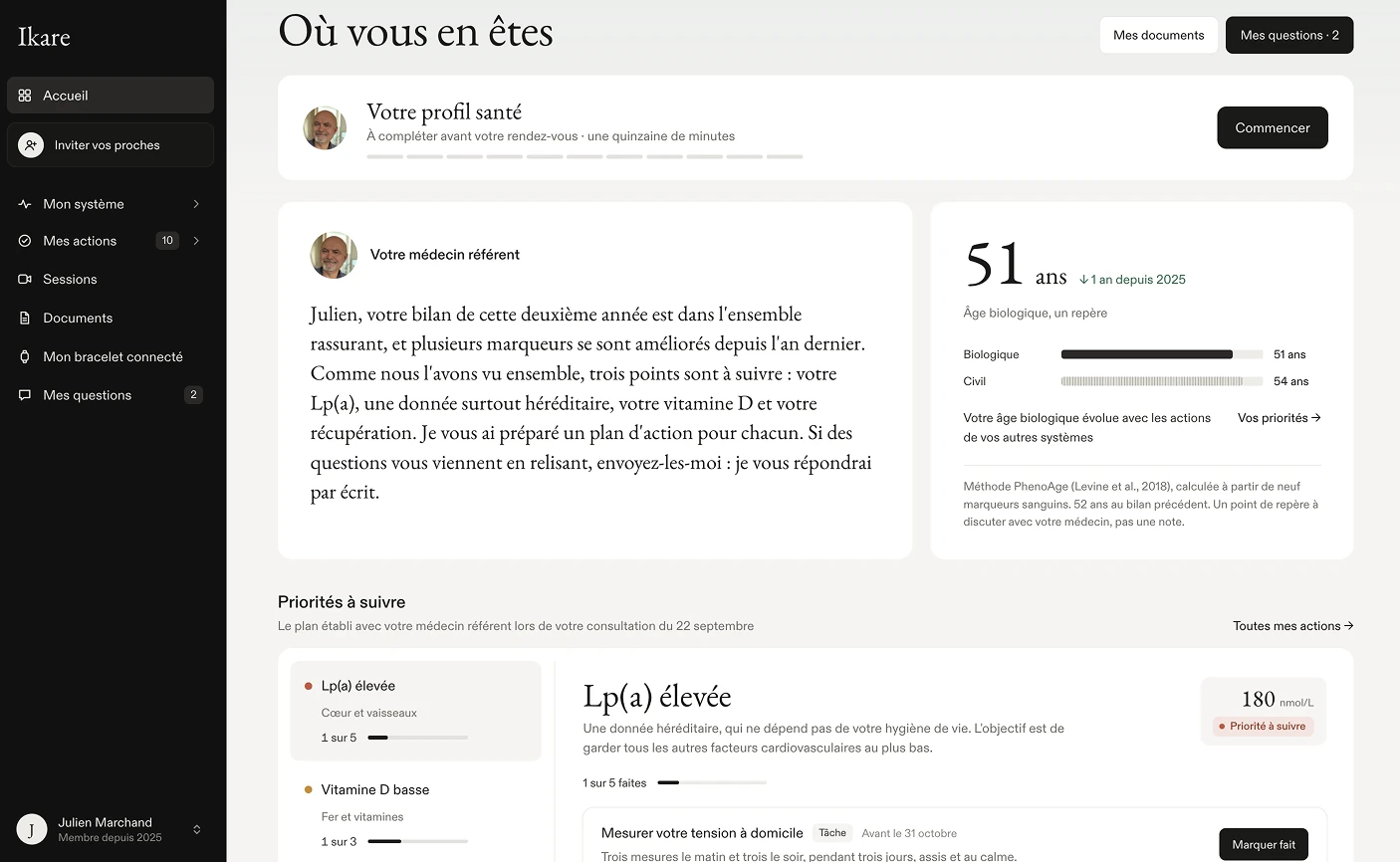
- Hormones, read alongside symptoms: these biomarkers help your dedicated doctor spot the first signs of perimenopause and adapt your action plan.
- The rest of the picture: lipids, ApoB, blood glucose, insulin, ferritin, vitamin D, blood pressure, grip strength, sleep.
- Follow-up: health coaching every month on diet, physical activity, sleep and stress, and a second blood draw in the sixth month.
- A referral if needed: Ikare does not prescribe hormone therapy. If the question comes up, your dedicated doctor refers you to your gynecologist or your primary care doctor.
Lost in the symptoms? The guide sorts them out.
At what age perimenopause starts, how long it lasts, and what a hormone panel really tells you. Free, by email.

Take stock, with a doctor.
We would be delighted to talk with you and answer your questions. By phone or on WhatsApp:
+33 7 66 72 57 31Let’s talk about your health.
Leave us your contact details: a member of the Ikare team calls you back at the time that suits you.
Book a free call Chat on WhatsAppFree, no commitment.
Sources
- Inserm. Ménopause : dossier d’information. inserm.fr
- Haute Autorité de santé. Traitements hormonaux de la ménopause. has-sante.fr
- Collège national des gynécologues et obstétriciens français, Groupe d’étude sur la ménopause et le vieillissement hormonal. Recommandations pour la pratique clinique : les femmes ménopausées, 2021. gemvi.org
- Assurance maladie. Ménopause : symptômes et diagnostic. ameli.fr
This guide is general information. It replaces neither a consultation nor the advice of your primary care doctor. In an emergency, call 15 or 112.