




Why fatigue sets in, the tests that bring clarity, the signs that mean you must see a doctor, and the levers that work.
A member of the team calls you back. Free, no commitment.
- More than 6 monthsThe duration that defines chronic fatigue
- 8 testsIn the first-line panel
- FerritinIron deficiency causes fatigue even without anemia
- Sleep, mood, activityThe leading causes
Key points
- Chronic fatigue is exhaustion that lasts more than six months and does not improve with rest. It is a symptom with multiple causes, often combined.
- The most common causes are sleep, stress, depression and anxiety, followed by iron deficiency, the thyroid, diabetes, medications and alcohol.
- The first-line blood panel includes a CBC, ferritin, CRP, TSH, fasting glucose, creatinine, transaminases and an electrolyte panel.
- Weight loss, prolonged fever, shortness of breath or bleeding along with fatigue mean you should see a doctor promptly.
- Chronic fatigue syndrome, or myalgic encephalomyelitis, is a distinct and rare disease, marked by prolonged malaise after exertion.
Updated November 12, 2026 · Sources
What is chronic fatigue?
We speak of chronic fatigue when exhaustion lasts more than six months and does not improve with rest. It is a symptom, not a diagnosis: it has many possible causes, physical, psychological or lifestyle-related, often combined.
Normal fatigue has an obvious cause and an end: a short night, an effort, a busy period. You sleep, and it passes. Fatigue becomes a reason to see a doctor when it sets in for no clear reason, limits your activities and is no longer repaired by sleep.
It is one of the most common reasons for seeing a primary care doctor. In most cases, the doctor finds one or more causes that can be acted on. It should not be confused with chronic fatigue syndrome, a disease in its own right, much rarer, described below.
What are the causes of chronic fatigue?
The most common are too little or poor-quality sleep, prolonged stress, depression and anxiety. Next come iron deficiency, thyroid disorders, diabetes, infections, certain medications and alcohol. Several causes often add up.
| Category | Causes | Clues |
|---|---|---|
| Sleep | Sleep debt, sleep apnea, shift work, insomnia | Snoring, daytime sleepiness, waking up unrefreshed |
| Psychological | Depression, anxiety, burnout | Loss of pleasure, rumination, fatigue from the morning on |
| Blood and iron | Anemia, iron deficiency without anemia | Shortness of breath, pallor, heavy periods, a diet low in iron |
| Hormones | Hypothyroidism, diabetes, testosterone deficiency, perimenopause | Feeling cold, weight gain, thirst, lower desire, irregular cycles |
| Infections and inflammation | Aftermath of a viral infection, inflammatory diseases | Fever, joint pain, swollen lymph nodes |
| Organs | Diseases of the heart, kidneys, liver, lungs | Shortness of breath, edema, jaundice |
| Medications and substances | Sleeping pills, anti-anxiety drugs, antihistamines, beta-blockers, alcohol, cannabis | Fatigue that appeared after a new treatment |
| Lifestyle | Sedentary lifestyle, overtraining, unbalanced diet, deficiencies | Fatigue that improves when you resume regular activity |
Being sedentary is tiring. It is counterintuitive, but the less you move, the less energy you have. Conversely, gradually resuming activity is one of the best-proven treatments for fatigue, whatever the cause.
In women, consider perimenopause from your forties on. In men, a testosterone deficiency is possible but rare. When work is the cause, read our page on burnout.
Which blood panel should you get for fatigue?
The first-line panel includes a complete blood count, ferritin, CRP, TSH, fasting glucose, creatinine, transaminases and an electrolyte panel. The doctor adapts it to your symptoms. A normal panel does not mean the fatigue is imaginary.
| Test | What it looks for |
|---|---|
| CBC (NFS) | Anemia, an infection |
| Ferritin | Iron deficiency, including without anemia |
| CRP | Inflammation or an infection |
| TSH | An underactive or overactive thyroid |
| Fasting glucose | Diabetes |
| Creatinine, electrolyte panel | Kidney damage, a sodium or potassium imbalance |
| Transaminases, GGT | Liver damage |
| Depending on the context | Vitamin B12, folate, vitamin D, calcium, serology tests, hormone panel |
Iron deficiency, an underestimated cause
You can be low in iron without being anemic. Hemoglobin is still normal, but the stores are empty, and the fatigue is already there. This is common in women with heavy periods, vegetarians, endurance athletes and blood donors. Only ferritin shows it. It is read alongside CRP, because inflammation raises it and can mask a deficiency. Our ferritin fact sheet explains how to interpret it.
When the panel is normal
This is the most common case, and it is useful information: serious causes are ruled out. The rest lies elsewhere: sleep, to be explored if you snore or feel drowsy; mood; workload; physical activity; alcohol and medications.
To understand the lines of your lab report, read how to read your blood test. For the full list of tests, see our guide to the complete blood panel.
Who interprets your results? Your doctors, over the long term.
Your results are read by a doctor registered with the French Medical Council, who follows you from one check-up to the next. Your doctor can prescribe additional tests and refer you to the right specialist if a result calls for it.
Around your doctor, a nutritionist and a fitness and wellness coach turn the recommendations into concrete actions. If your doctor were to leave, a colleague takes over your file with your full history. Our medical standards


When should you see a doctor for fatigue?
When it lasts more than two to three weeks with no obvious cause, keeps you from your usual activities, or comes with other signs. Some signs mean you should see a doctor promptly.
See a doctor without delay if the fatigue comes with
- unintentional weight loss;
- fever or night sweats that persist;
- shortness of breath, chest pain, palpitations;
- unusual bleeding, black stools;
- lymph nodes that keep growing;
- intense thirst and very frequent, heavy urination;
- deep sadness or dark thoughts: call your doctor, 3114 or 15.
What the doctor will look for
They will ask you since when, at what time of day, what makes it worse and what relieves it. They will review your sleep, your mood, your medications, your alcohol intake. They will examine you, then order the appropriate panel. Prepare these answers: they point the way more than any test.
What is chronic fatigue syndrome?
Chronic fatigue syndrome, or myalgic encephalomyelitis, is a distinct disease. It combines disabling fatigue for more than six months, malaise after exertion that can last several days, unrefreshing sleep and trouble concentrating. No test can confirm it.
Its most characteristic sign is post-exertional malaise: after physical or mental activity, even moderate, symptoms get markedly worse, with a delay of a few hours to a day, and for a long time. This is what sets it apart from ordinary fatigue, which improves with gradual activity.
The diagnosis is made by a doctor, after ruling out other causes. There is no curative treatment to date. Care relies on energy management, to stay below the threshold that triggers relapses, and on treating the symptoms. Similar symptoms are described after certain viral infections, including Covid-19.
How do you get your energy back?
By treating the cause when there is one, then by acting on four levers: sleep, physical activity, diet and recovery. The effects are measured in weeks, not days.
- Sleep: regular hours, seven to eight hours, no screens or alcohol late in the evening. Snoring with sleepiness warrants screening for sleep apnea.
- Physical activity: start low, increase slowly. Thirty minutes of brisk walking most days already changes your energy level.
- Diet: regular meals, enough protein, iron and vegetables, fewer fast sugars, which give you a boost and then a crash.
- Caffeine: none after early afternoon. It masks fatigue and degrades the following night’s sleep.
- Recovery: real breaks, days without work, time outdoors.
- Supplements: useful to correct a proven deficiency, in iron or vitamin D for example. Without a deficiency, they have no proven effect on fatigue. Iron should not be taken without a blood test.
How do you look for the cause over time?
Fatigue that lasts cannot be understood from a single blood test. You need a broad measurement at the start, then a second one that shows whether what was corrected had an effect.
The first measurement
The kit arrives at your home. The nurse draws your blood in the morning, at home or at the office, before the day’s fatigue blurs the results.
Sorting the leads
Your dedicated doctor rules out the most likely causes by video call, about a month later, and identifies what deserves to be corrected first.
Regular follow-up
The plan is reviewed every month: sleep, iron, thyroid, blood glucose. The medical team replies by message when a symptom changes.
The six-month check
A second blood test, at your home, checks that the targeted parameters have really moved.
The one-year comparison
The twelfth-month tests are reviewed alongside the first ones: the improvement, or its absence, becomes verifiable.
Tired for months? We’ll call you back to talk about it. Free, no commitment.
How does Ikare approach fatigue that lasts?
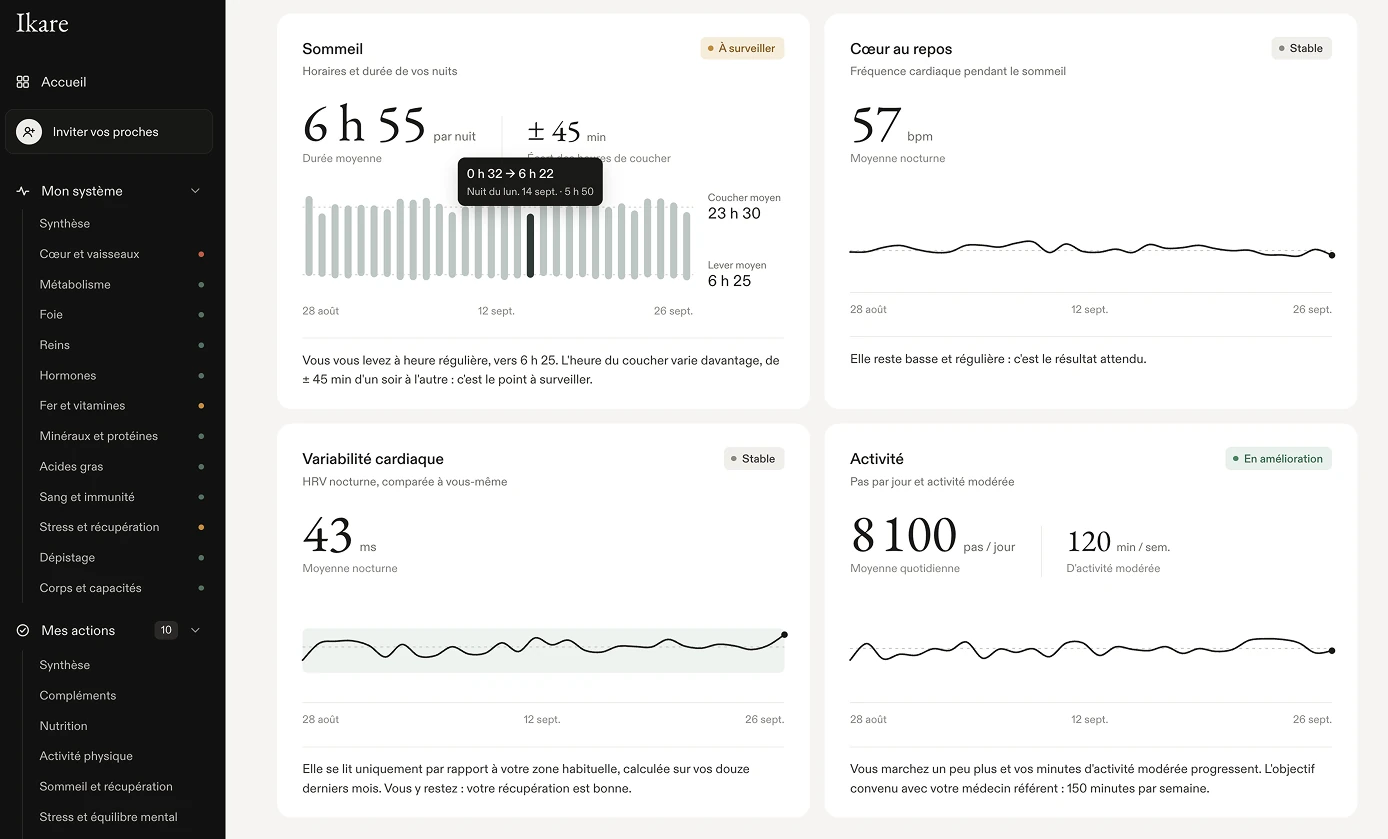
The Ikare check-up measures more than 90 biomarkers, including a full iron panel, thyroid, glucose and insulin, vitamins, hormones and salivary cortisol. A connected wristband tracks your sleep and recovery. A doctor cross-checks it all.
- A broader panel than the standard one: ferritin, iron, transferrin and saturation; TSH, free T4 and free T3; vitamin B12, folate, vitamin D, magnesium, zinc; testosterone or estradiol and FSH depending on sex.
- Measured sleep: duration, regularity, deep sleep, nighttime heart rate and heart rate variability.
- A doctor who sorts out what explains the fatigue, what does not, and what calls for a specialist’s opinion.
- Health coaching every month on sleep, activity, diet and recovery, then a second blood draw at six months to check what has changed.
Ikare does not replace your primary care doctor. Fatigue that is recent, intense or accompanied by the warning signs described above should be shown to them first.
Where to start? The guide gives you the order.
The most common causes of persistent fatigue, the panel to ask for and the signs that call for prompt medical advice. Free, by email.

Understand your fatigue, with a doctor.
We would be delighted to talk with you and answer your questions. By phone or on WhatsApp:
+33 7 66 72 57 31Let’s talk about your health.
Leave us your contact details: a member of the Ikare team calls you back at the time that suits you.
Book a free call Chat on WhatsAppFree, no commitment.
Sources
- Assurance maladie. Fatigue: causes et conduite à tenir. ameli.fr
- Inserm. Encéphalomyélite myalgique, syndrome de fatigue chronique: dossier d’information. inserm.fr
- National Institute for Health and Care Excellence. Myalgic encephalomyelitis (or encephalopathy)/chronic fatigue syndrome: diagnosis and management, NG206, 2021. nice.org.uk/guidance/ng206
- Haute Autorité de santé. Choix des examens du métabolisme du fer en cas de suspicion de carence en fer, 2011. has-sante.fr
This guide is general information. It replaces neither a consultation nor the advice of your primary care doctor. In an emergency, call 15 or 112.
Further reading
- Burnout: symptoms, causes and early signs
- Perimenopause: symptoms, age and hormone panel
- Andropause: age, symptoms and testosterone
- Ferritin: normal level, low or high ferritin
- TSH: normal level and interpretation
- Complete blood panel: list of tests, prices, fasting
- Reading your blood test: abbreviations and reference ranges