




How to recognize it, what sets it apart from depression or simple fatigue, what a blood test can tell you, and who to turn to.
A member of the team calls you back. Free, no commitment.
- 3 dimensionsExhaustion, detachment, loss of effectiveness
- No blood biomarkerThe diagnosis is clinical
- 3114Suicide prevention, day and night
- Your primary care doctorFirst point of contact
Key points
- Burnout, or occupational exhaustion syndrome, results from chronic stress at work. The WHO describes it through three dimensions: exhaustion, detachment from work, loss of effectiveness.
- Its signs: fatigue that rest no longer repairs, trouble sleeping and concentrating, irritability, cynicism, pain.
- No blood test diagnoses burnout, not even cortisol. A panel serves to rule out a physical cause: anemia, iron deficiency, thyroid, diabetes.
- The first point of contact is your primary care doctor. Sick leave, psychotherapy and preparing the return to work are the pillars of care.
- If you have dark thoughts, call 3114, free and open day and night, or 15.
Updated November 12, 2026 · Sources
What is burnout?
Burnout, or occupational exhaustion syndrome, is physical, emotional and mental exhaustion caused by chronic workplace stress that has not been successfully managed. The World Health Organization describes it through three dimensions: exhaustion, distance from one’s job and loss of effectiveness.
In its International Classification of Diseases, the WHO lists burnout among work-related phenomena, not among diseases. That does not mean it is not serious. It means it is defined by its origin, work, and that it can lead to real illnesses: depression, anxiety disorders, cardiovascular disease.
Burnout does not come out of nowhere. It sets in over months, often in highly committed people who compensate for a long time. That is what makes it hard to see coming: right up to the end, you hold on.
What are the symptoms of burnout?
Fatigue that rest no longer repairs, detachment or cynicism toward work, and the feeling of no longer coping. Added to these are sleep, concentration and mood problems, and physical signs.
| Area | Signs |
|---|---|
| Emotional | Exhaustion, irritability, anxiety, sadness, a feeling of emptiness, loss of pleasure in work |
| Cognitive | Memory and attention problems, difficulty deciding, unusual mistakes |
| Physical | Constant fatigue, unrefreshing sleep, headaches, back and neck pain, digestive problems, recurring infections |
| Behavioral | Withdrawal, cynicism, aggressiveness, increased use of alcohol, tobacco or medications |
| Motivational | Disengagement, doubts about your abilities, a sense of no longer having control over anything |
The early signals
- You no longer recover over the weekend or during vacations.
- You wake up at 4 a.m. thinking about work.
- You become cynical about things you used to care about.
- You put in more hours for less result.
- The people around you say you have changed.
If you have dark thoughts, do not wait. Call 3114, the French national suicide prevention line, free and open day and night, or 15.
Burnout, depression, fatigue: what is the difference?
Burnout is tied to work and improves, at first, when you step away from it. Depression affects every area of life. Simple fatigue gives way to rest. The three can follow one another or overlap: only a doctor can tell them apart.
| Fatigue | Burnout | Depression | |
|---|---|---|---|
| Origin | Exertion, lack of sleep, illness | Chronic stress at work | Multiple, sometimes with no identifiable cause |
| Areas affected | All, temporarily | Work first | All of life: work, family, leisure |
| Effect of rest | Recovery | Partial improvement, at first | Little or no effect |
| Central sign | Need for sleep | Exhaustion and detachment from work | Lasting sadness, general loss of pleasure |
Burnout that lasts can develop into depression. And a physical illness can mimic both: an underactive thyroid, anemia or sleep apnea produce the same fatigue and the same brain fog. That is why a consultation and a check-up are useful before drawing conclusions.
Is there a blood test for burnout?
No. No blood biomarker diagnoses burnout, not even cortisol. The diagnosis is clinical: it rests on a conversation with a doctor. A blood test serves to rule out the physical causes of exhaustion.
| Test | What it looks for |
|---|---|
| CBC and ferritin | Anemia or iron deficiency |
| TSH | A thyroid disorder |
| Fasting glucose, HbA1c | Diabetes |
| CRP | Inflammation or a lingering infection |
| Creatinine, transaminases, electrolyte panel | Kidney or liver damage, an electrolyte imbalance |
| Vitamin B12, folate, vitamin D | Deficiencies |
What about cortisol?
Cortisol is the stress hormone, and it is tempting to look to it for proof. Studies show no single profile: depending on the person and the stage, it can be high, normal or low. A cortisol test neither confirms nor rules out burnout. It tells you about the rhythm of the stress axis, and is read alongside sleep and recovery.
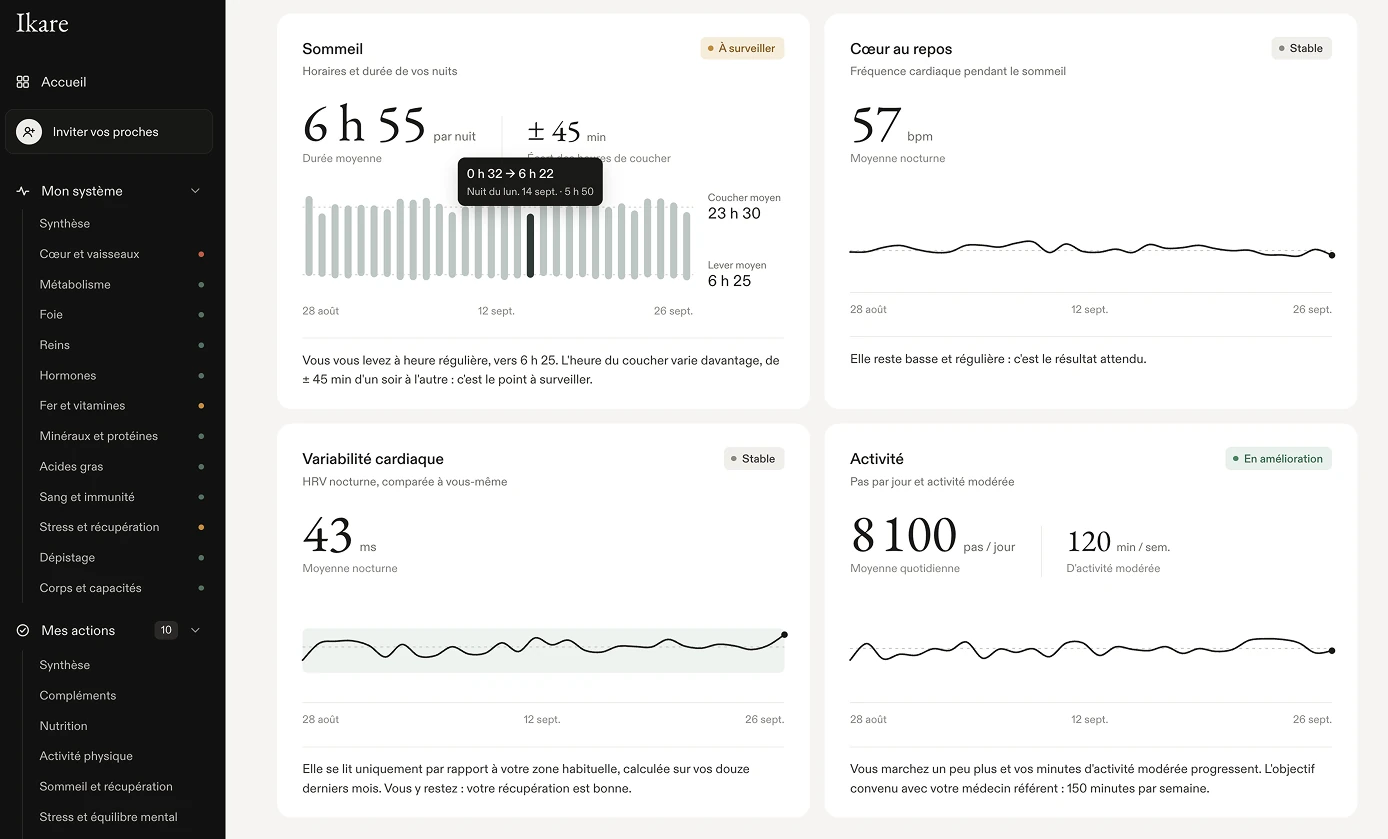
Chronic stress does, however, leave traces that can be measured and tracked: blood pressure, waist circumference, blood glucose, lipids, sleep quality, heart rate variability. That is how it damages health over the long term.
For details on the tests, read our guide to the complete blood panel and our page on chronic fatigue.
Who interprets your results? Your doctors, over the long term.
Your results are read by a doctor registered with the French Medical Council, who follows you from one check-up to the next. Your doctor can prescribe additional tests and refer you to the right specialist if a result calls for it.
Around your doctor, a nutritionist and a fitness and wellness coach turn the recommendations into concrete actions. If your doctor were to leave, a colleague takes over your file with your full history. Our medical standards


What should you do in case of burnout?
See your primary care doctor. They assess the situation, rule out another cause, prescribe sick leave if necessary and refer you to a psychologist or psychiatrist. The occupational health physician steps in to prepare the return to work.
- Your primary care doctor is the first point of contact. They make the diagnosis, look for depression or suicide risk, and coordinate what comes next.
- Sick leave is not a failure. It is often the condition for body and mind to recover. Its length is adjusted as needed.
- Psychotherapy helps you understand what led there and how not to go back. Antidepressant treatment is only indicated when there is associated depression or an anxiety disorder.
- The occupational health physician can be contacted by the employee at any time. They offer a pre-return visit and workplace adjustments.
- The return to work needs preparing. Going back to the same job, under the same conditions, exposes you to relapse.
Is burnout an occupational disease?
It does not appear in any of the French occupational disease tables. It can be recognized case by case by a regional committee, if the direct link with work is established and if it results in a permanent disability of at least 25%. The claim is filed with the French national health insurance fund.
Why are executives and the self-employed at risk?
Because they combine a heavy workload, financial responsibility and loneliness in decision-making, and because they have neither occupational medicine nor easy access to sick leave. They see a doctor late, when the body has already given out.
An employee in difficulty has, in theory, safeguards: a manager, colleagues, an occupational health service. An executive or a self-employed professional is often the only one who can call a halt. For them, stopping means putting the business at risk. So they do not stop.
The warning signals are the same as for everyone, but they read differently: decisions you keep putting off, irritability with the team, four-hour nights, the evening drink that becomes a habit, the exercise you have dropped.
Prevention comes down to a few things, repeated: protected sleep, sustained physical activity, real breaks, and a regular outside look at your health. That is the subject of our health guide for executives, men and women and of our health guide for the self-employed.
What happens after the diagnosis?
Recovering from burnout takes months, not one consultation. Ikare’s follow-up is calibrated to that timescale: an initial measurement, regular support, an objective check at the halfway point.
The initial measurement
The kit is sent to your home. A nurse draws your blood in the morning, on site, before the day begins.
The medical review
About a month later, your dedicated doctor reads your results by video call, alongside your sleep, your workload and your recovery.
Long-term support
The plan is reviewed every month, at the pace of your actual recovery. The medical messaging service stays open between sessions.
The halfway check
In the sixth month, a new at-home blood draw gives an objective measure of what feelings alone cannot gauge.
The year-end check-up
At twelve months, the tests are repeated and compared with the first ones: recovery becomes something you can see.
A member of the team will call you back to talk about follow-up after burnout. Free, no commitment.
What can Ikare do, and what can it not do?
Ikare does not diagnose or treat burnout: that is the role of your primary care doctor and a mental health professional. Ikare measures what chronic stress does to your body, rules out the physical causes of exhaustion, and helps you keep up the basics over time.
- Measure: more than 90 biomarkers, including thyroid, iron, glucose and inflammation, salivary cortisol on waking and thirty minutes later, blood pressure, sleep and heart rate variability thanks to the connected wristband.
- Explain: a doctor registered with the French Medical Council reads everything and tells you what is due to stress, what is due to something else, and what calls for a specialist’s opinion.
- Support: health coaching every month on sleep, physical activity, diet and recovery, with a second check-up at six months.
- Refer: if your dedicated Ikare doctor spots signs of exhaustion or depression, they refer you to your primary care doctor or a specialist.
If you are in distress, do not wait for a follow-up appointment: call your doctor, 3114 or 15.
Tired without knowing why? The guide helps you sort it out.
What the body says before the collapse, the tests that rule out other causes, and the steps to take. Free, sent by email.

Take care of yourself, before the breaking point.
We would be delighted to talk with you and answer your questions. By phone or on WhatsApp:
+33 7 66 72 57 31Let’s talk about your health.
Leave us your contact details: a member of the Ikare team calls you back at the time that suits you.
Book a free call Chat on WhatsAppFree, no commitment.
Sources
- World Health Organization. Burn-out an “occupational phenomenon”: International Classification of Diseases, 2019. who.int
- Haute Autorité de santé. Repérage et prise en charge cliniques du syndrome d’épuisement professionnel ou burnout, fiche mémo, 2017. has-sante.fr
- Assurance maladie. Maladie professionnelle hors tableau: la reconnaissance. ameli.fr
- French national suicide prevention line. 3114.fr
This guide is general information. It replaces neither a consultation nor the advice of your primary care doctor. In an emergency, call 15 or 112.
Further reading
- Chronic fatigue: causes and blood panel
- The health guide for executives, men and women
- The health guide for the self-employed
- Complete blood panel: list of tests, prices, fasting
- Comprehensive health check-up: price and where to get one
- Andropause: age, symptoms and testosterone
- Perimenopause: symptoms, age and hormone panel