




What a complete health check-up includes, the five ways to get one in France, what is free, what is not, and what to expect from it.
A member of the team calls you back. Free, no commitment.
- 5 ways to get oneFrom the national health insurance center to private follow-up
- Free from age 16The preventive health exam
- 1 in 3 adults has hypertensionAnd half of them don’t know it
- Twelve months of follow-upWith Ikare, after the check-up
Key points
- A complete health check-up combines an interview, a physical exam, a blood test, a urinalysis, functional tests and the screenings recommended for your age.
- French national health insurance offers a free preventive health exam, from age 16, in its health examination centers, and the Mon bilan prévention program at four stages of life.
- A check-up in a private center or a hospital costs from a few hundred to several thousand euros. It is not reimbursed by French national health insurance.
- A one-off check-up gives you a snapshot. Without follow-up, it rarely changes habits: what happens afterward is what counts.
- Ikare combines a check-up of more than 90 biomarkers, a dedicated doctor and twelve months of health coaching, for €129 per month.
Updated November 12, 2026 · Sources
What is a complete health check-up?
A complete health check-up is a set of exams performed on a person with no complaints, to spot risk factors or silent diseases early. It combines an interview, a physical exam, a blood test and, depending on age, tests and screenings.
“Health check-up,” “health assessment,” “preventive check-up”: these words describe the same approach. You are not looking for the cause of a symptom. You are taking stock, while everything seems fine, of what could become a problem later.
The reason for this approach is simple. The diseases that weigh most on healthy life expectancy set in quietly. In France, nearly one in three adults has hypertension, and about half of them don’t know it, according to the Esteban study by Santé publique France. Type 2 diabetes, high cholesterol or early kidney disease don’t hurt either. By the time symptoms appear, years have often gone by.
A health check-up does not replace follow-up by your primary care doctor. It feeds it: it gives your doctor measurements, and gives you a starting point.
What does a complete health check-up include?
A complete check-up has six parts: a questionnaire on your medical history and lifestyle, a physical exam with blood pressure and weight, a blood panel, a urinalysis, functional tests and the screenings recommended for your age. Imaging is only useful when there is a specific indication.
| Part | What is done | Why |
|---|---|---|
| Interview | Personal and family history, medications, smoking, alcohol, sleep, physical activity, stress | Half of the diagnosis lies in the person’s history |
| Physical exam | Blood pressure, heart rate, weight, height, waist circumference, auscultation | Spot hypertension and abdominal obesity |
| Blood panel | CBC, blood glucose, lipid panel, liver, kidneys, thyroid, iron, inflammation | Screen for diabetes, high cholesterol, anemia, liver or kidney damage |
| Urinalysis | Testing for protein, blood and sugar | An early sign of kidney damage |
| Functional tests | Vision, hearing, lung function, muscle strength, electrocardiogram in some cases | Measure what blood doesn’t show |
| Screenings | Breast, cervical and colorectal cancer depending on age and sex; up-to-date vaccines | The programs with proven benefit |
The lab portion is covered in detail in our guide to the complete blood panel: list of tests, fasting, prices and how to read the results.
What about imaging?
Whole-body CT scans, MRI, a series of ultrasounds: some centers make them a selling point. In a person with no symptoms or risk factors, these exams often find harmless images, which lead to more exams, worry and sometimes unnecessary procedures. An imaging exam is decided on a specific question, asked by a doctor. More exams does not mean a better check-up.
Where can you get a complete health check-up?
In France, there are five routes: the free preventive health exam from French national health insurance, the Mon bilan prévention program, your primary care doctor, a check-up in a private center or a hospital, and year-long follow-up like Ikare’s. They differ in price, in content and in what comes next.
| Price | Who it’s for | What is done | And afterward | |
|---|---|---|---|---|
| Preventive health exam | Free | People covered by the general scheme from age 16, with priority for those with little access to care | Interview, exams and lab tests adapted to age, in a health examination center | Report, referral to your primary care doctor |
| Mon bilan prévention | Free | Ages 18-25, 45-50, 60-65, 70-75 | A 30- to 45-minute interview with a doctor, pharmacist, nurse or midwife | A personalized prevention plan |
| Primary care doctor | €30 per visit, partly reimbursed | Everyone | Physical exam and lab tests prescribed according to your situation | Usual follow-up |
| Check-up in a private center or a hospital | From a few hundred to several thousand euros, not reimbursed | By appointment | Half a day to a full day on site: lab work, tests, sometimes imaging | A report; what comes next is up to you |
| Year-long follow-up with Ikare | €129 per month | By membership, anywhere in France | 90+ biomarkers, seven at-home tests, blood draw at your home or office | Dedicated doctor, monthly coaching, second blood draw at six months |
These routes are not mutually exclusive. If you are eligible for a free program, use it: it is a good starting point. Follow-up like Ikare’s goes further on two points, the breadth of the check-up and support over time.
How do you get the free health check-up from French national health insurance?
The preventive health exam is free, with nothing to pay up front. It is open to people covered by the general scheme from age 16 and takes place in a health examination center. To sign up, contact your local health insurance office (caisse primaire d’assurance maladie) or the center nearest you.
The preventive health exam
It takes about two hours. You fill in a questionnaire, then have exams chosen according to your age, sex and risks: blood and urine tests, measurements, a dental exam, vision or hearing tests depending on the center. A doctor then reviews everything with you. You are given the results and, with your consent, they are sent to your primary care doctor.
The exam is offered first to people with little medical follow-up: young people in job-integration programs, job seekers, people in precarious situations, people without a primary care doctor. If you are followed regularly, the center may offer you a later date or refer you to your doctor.
Mon bilan prévention
This is a more recent program. It is not a set of exams, but a 30- to 45-minute interview, 100% covered, at four points in life: between ages 18 and 25, 45 and 50, 60 and 65, 70 and 75. You do it with a doctor, pharmacist, nurse or midwife. You prepare for the conversation with a questionnaire, and you leave with a personalized prevention plan. No lab test is planned by default: the professional can refer you if needed.
What about employees and the self-employed?
The occupational health visit is not a health check-up: it checks that your job is not harming your health. Some complementary health insurers and pension funds offer their own preventive check-ups to their members. Self-employed professionals and non-salaried executives have no occupational health service. Ikare was designed partly for them, and we come back to this in the health guide for the self-employed.
How much does a complete health check-up cost?
From zero to several thousand euros. The French national health insurance exam and Mon bilan prévention are free. With your primary care doctor, you pay for the visit, €30, and the prescribed lab tests are partly reimbursed. A private check-up is not reimbursed, and its price depends mostly on the imaging included.
What makes the price vary
- The number of lab tests: a standard blood panel has ten to fifteen measurements; an in-depth panel, several dozen.
- Imaging: ultrasounds, CT scan, MRI or a stress test account for most of the price of the most expensive packages.
- Doctor time: a fifteen-minute review consultation and a one-hour one do not cost the same.
- The location: a private hospital in the heart of a big city also bills for its setting.
- Follow-up: most check-ups stop when the report is handed over.
What is reimbursed
French national health insurance reimburses care prescribed for a medical reason. A check-up you freely choose in a private center does not fall within that scope. Some complementary health insurance plans include a prevention allowance: reread your contract. If you run a company, a prevention membership can be paid for by the business. Talk to your accountant about it.
The right math
Comparing prices only makes sense if you compare the same thing. An €800 check-up that ends with a PDF and a €1,548 follow-up that lasts twelve months do not answer the same question. Always ask: what is being measured, who explains it to me, and what happens next?
At what age should you get a complete health check-up?
There is no official age. A first baseline check-up is useful between 30 and 40. From 40 to 45 onward, heart and metabolic monitoring becomes regular. At 50, organized screening for breast and colon cancer begins. A family history moves this schedule forward.
| Age | What becomes important | Organized screenings in France |
|---|---|---|
| Ages 18 to 30 | Vaccines, sexual health, smoking, alcohol, mental health; a check-up if there is a family history | Cervical from age 25 |
| Ages 30 to 40 | First baseline check-up: blood pressure, lipids, blood glucose, weight, sleep; one-time Lp(a) measurement | Cervical |
| Ages 40 to 50 | Cardiovascular risk, prediabetes, liver; perimenopause in women; Mon bilan prévention between 45 and 50 | Cervical |
| Ages 50 to 65 | Heart, metabolism, bones, vision, hearing; prostate to be discussed with their doctor for men | Breast and colon from 50 to 74, cervical up to 65 |
| After 65 | Muscle strength, balance, memory, hearing, nutrition; vaccines for older adults | Breast and colon up to 74 |
These guidelines describe a person with no particular risk. A parent who had a heart attack before 55, diabetes in the family, colon or breast cancer in a young relative: talk to your doctor, the schedule will not be the same.
The content also changes by sex. Our women’s health check-up and men’s health check-up pages detail the biomarkers specific to each.
Who interprets your results? Your doctors, over the long term.
Your results are read by a doctor registered with the French Medical Council, who follows you from one check-up to the next. Your doctor can prescribe additional tests and refer you to the right specialist if a result calls for it.
Around your doctor, a nutritionist and a fitness and wellness coach turn the recommendations into concrete actions. If your doctor were to leave, a colleague takes over your file with your full history. Our medical standards

What are the limits of a one-off check-up?
A one-off check-up gives you a snapshot at a given moment. It does not tell you whether your biomarkers are improving or worsening, it can cause needless worry, and it rarely changes habits. Its value depends on what happens afterward.
A snapshot, not a movie
A normal blood glucose today says nothing about its trend. Two measurements six months apart tell you far more than a single one, however detailed.
False alarms
The more exams you run on a healthy person, the more minor, inconsequential abnormalities you find. Each one calls for a follow-up check. That is why a good check-up is built around measurements of established value, not around the largest possible number of exams.
Knowing is not enough
Learning that your cholesterol is too high does not bring it down. The changes that matter, diet, physical activity, sleep, stress management, take months and support. Without a plan or follow-up appointments, the report ends up in a drawer.
Ikare is built on this observation: a broad check-up at the start, a doctor who sets the priorities, health coaching every month, and a second blood draw at six months to check that the effort is paying off.
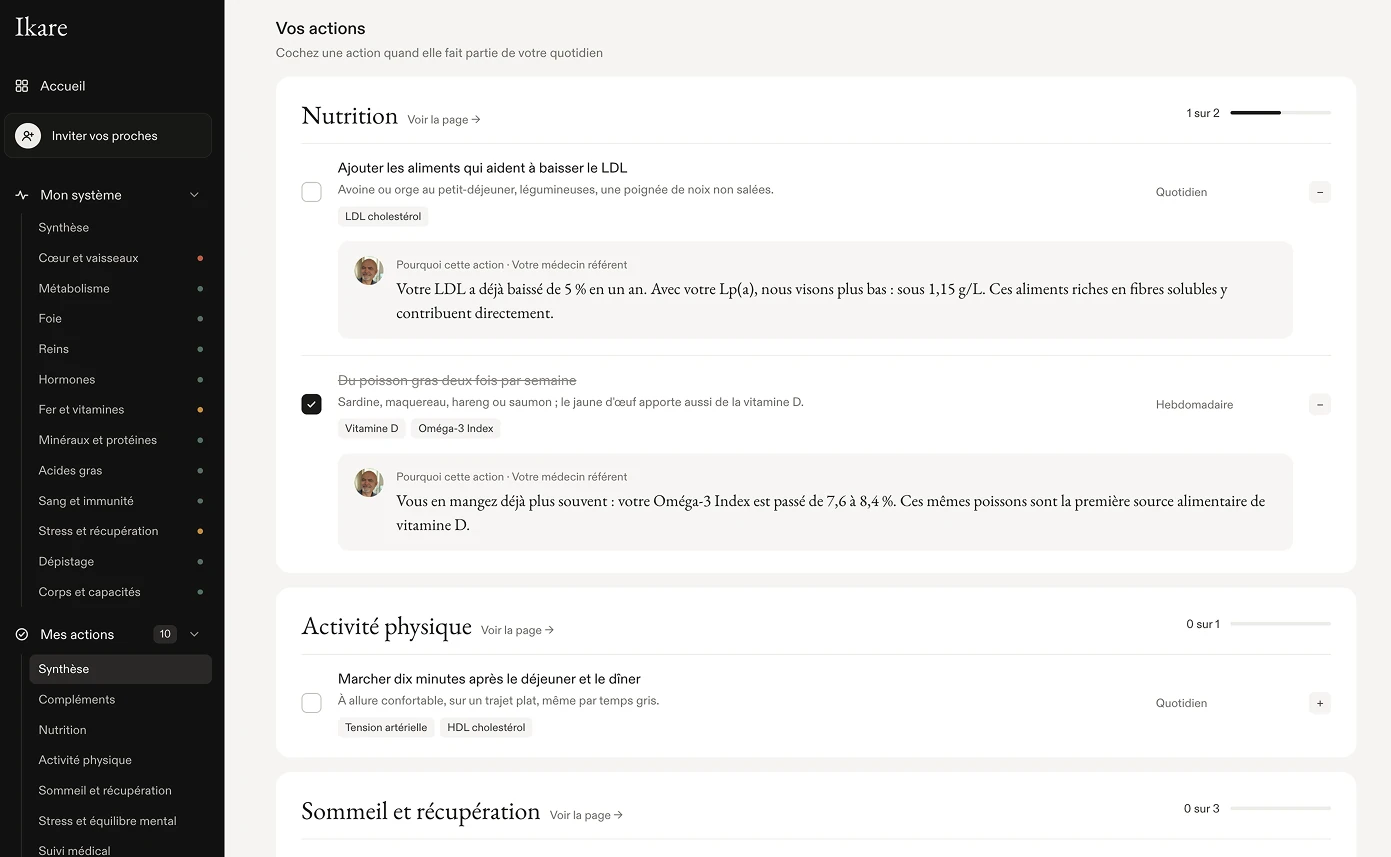
What does a check-up over time look like?
A complete check-up is not a snapshot you file away. Ikare spreads it over twelve months, with a baseline measurement, a midpoint review and a final comparison.
The baseline measurement
The kit is delivered to your home. The nurse draws your blood in the morning, where you live or work, and the tests are done right afterward.
The medical debrief
About a month later, your dedicated doctor goes through your results with you by video call and picks two or three priorities rather than thirty.
The plan settles in
Each month, the support adjusts to what you actually manage to keep up. The medical team stays reachable by message.
The midpoint review
In the sixth month, a second blood test is done at your home, followed by a conversation with your doctor about what has changed.
The final comparison
In the twelfth month, the exams are repeated and set against the first ones. The check-up becomes a documented trajectory.
Want to know what the check-up includes before you decide? We’ll call you back to talk about it. Free, no commitment.
How do you prepare for a health check-up?
Come having fasted for 8 to 12 hours, and having drunk water. Avoid alcohol and intense exercise the day before. Gather your latest lab results, the list of your medications and the medical history of your parents, brothers and sisters.
- The day before: your usual dinner, no alcohol, no intense workout, a normal night’s sleep.
- In the morning: fasting, water only, no coffee or cigarette before the blood test.
- What to bring: your previous results, your current prescriptions, the list of your dietary supplements, your vaccination record.
- What to prepare: the illnesses of your close relatives and the age at which they appeared, your questions, and what you would like to change.
- For women: note the date of your last period; some hormone levels are read according to the point in the cycle.
With Ikare, everything happens at home. The kit arrives by mail, a nurse comes to draw your blood in the morning, at home or at the office, and you do the seven tests at your own pace. You don’t block out a day.
Comparing packages and prices? The guide takes care of it.
What a complete check-up covers, what French national health insurance reimburses and where private check-ups stand. Free, sent by email.

Your health check-up starts here.
We would be delighted to talk with you and answer your questions. By phone or on WhatsApp:
+33 7 66 72 57 31Let’s talk about your health.
Leave us your contact details: a member of the Ikare team calls you back at the time that suits you.
Book a free call Chat on WhatsAppFree, no commitment.
Sources
- Assurance maladie. The preventive health exam. ameli.fr
- French Ministry of Health. Mon bilan prévention. sante.gouv.fr
- Santé publique France. Esteban study 2014-2016: undiagnosed hypertension. santepubliquefrance.fr
- Institut national du cancer (French National Cancer Institute). Organized screening for breast, colorectal and cervical cancer. e-cancer.fr
- Mach F et al. 2019 ESC/EAS Guidelines for the management of dyslipidaemias. European Heart Journal, 2020. doi.org/10.1093/eurheartj/ehz455
This guide is general information. It replaces neither a consultation nor the advice of your primary care doctor. In an emergency, call 15 or 112.
Further reading
- Zoī review: the Zoī clinic in Paris, check-up prices
- Lucis review: prices, check-up and customer reviews
- Complete blood panel: list of tests, prices, fasting
- The 90+ biomarkers of the Ikare check-up
- Women’s health check-up
- Men’s health check-up
- Health check-up in Lyon
- Health check-up in Marseille
- The health guide for executives, men and women
- Lucis, Zoī, Ikare: the comparison
- Chronic fatigue: causes and blood panel
- Frequently asked questions