




The calculation methods, from the blood test to the epigenetic test, what the number means, what it doesn’t say, and what moves it.
A member of the team calls you back. Free, no commitment.
- 9 blood biomarkersIn the PhenoAge method
- 2018Published by a Yale team
- 4 families of methodsOf uneven reliability
- Two measurementsTo read a trend
Key points
- Biological age estimates the state of the body in years, to compare it with chronological age. It is a statistical indicator, not a diagnosis.
- There are four families of methods: blood-test calculations such as PhenoAge, epigenetic clocks, telomeres, online questionnaires. They do not give the same number.
- PhenoAge, published in 2018 by a Yale team, combines chronological age and nine common blood biomarkers, including blood glucose, CRP, albumin and creatinine.
- The result is imprecise at the level of one person and sensitive to a recent infection. Its value lies in how it changes from one measurement to the next.
- You can improve the biomarkers it is built from through lifestyle. It has not been shown that lowering your biological age extends life.
Updated November 12, 2026 · Sources
What is biological age?
Biological age is an estimate of the state of your body, expressed in years. It is compared with your chronological age, the one on your ID. A lower biological age suggests your body is aging more slowly than average; a higher one suggests the opposite.
Two 50-year-olds do not have the same body. One runs, sleeps well and has flexible arteries. The other smokes, has gained belly fat and has high blood pressure. Chronological age treats them as equals; biological age tries to tell them apart.
There is not one biological age, but several ways of estimating it, which do not measure the same thing and do not give the same number. None is a diagnosis. All are statistical indicators, built by observing what, in large populations, predicts earlier death or disease.
How is biological age calculated?
There are four families of methods: calculations based on a routine blood test, such as PhenoAge; epigenetic clocks, which read chemical marks on DNA; telomere measurement; and online questionnaires. Their reliability is very uneven.
| Method | What it measures | Sample | Benefit | Limitation |
|---|---|---|---|---|
| PhenoAge | Nine common blood biomarkers and age | Standard blood test | Published, reproducible, inexpensive; each biomarker is understandable and modifiable | Sensitive to a passing infection or inflammation |
| Epigenetic clocks | Methylation marks on DNA | Blood or saliva, specialized laboratory | The most studied in research | Results vary from one test to another; hard to know what to change |
| Telomere length | The ends of chromosomes | Blood | A simple idea to understand | Unreliable at the level of one person |
| Online questionnaires | Your self-reported habits | None | Free, gets you thinking | Measures nothing: it is a risk estimate, not a biological age |
What is the PhenoAge method?
PhenoAge is a method published in 2018 by a team at Yale University. It calculates a biological age from chronological age and nine blood biomarkers: albumin, creatinine, blood glucose, CRP, lymphocyte percentage, mean corpuscular volume, red cell distribution width, alkaline phosphatase and white blood cells.
| Biomarker | What it reflects |
|---|---|
| Albumin | Nutritional status, liver function |
| Creatinine | Kidney function |
| Blood glucose | Sugar metabolism |
| CRP | Inflammation |
| Lymphocyte percentage | Immunity |
| Mean corpuscular volume (MCV) | Size of red blood cells |
| Red cell distribution width (RDW) | How uniform their size is |
| Alkaline phosphatase | Liver and bone |
| White blood cells | Immunity and inflammation |
The strength of this method is its transparency. Each biomarker is a routine test that any laboratory can run, and whose meaning is understood. When biological age diverges from chronological age, you can look at which of the nine is responsible, and act on it.
Its limitation is the same. A flu the week before raises CRP and white blood cells, and ages the result by several years. Hence two rules: have the blood drawn when you have no infection, and never draw conclusions from a single measurement.
What is a biological age result worth?
At the level of a population, biological age predicts the risk of disease and death better than chronological age. At the level of one person, the number is imprecise: it can vary by a few years from one measurement to the next. Its value lies in how it changes over time.
- It is not a diagnosis. A biological age five years higher does not mean you are sick. It is an invitation to look at the biomarkers it is built from.
- It is not a prediction. It does not say how many years you have left.
- The methods are not comparable. A PhenoAge result and an epigenetic clock result can differ by several years in the same person.
- A single number says little. Two measurements six or twelve months apart, under the same conditions, say much more.
Tests sold online
Saliva kits promise to reveal your biological age for one hundred to several hundred euros. The science of epigenetic clocks is serious; its commercial use is less so. The result arrives with no doctor to interpret it, with no indication of what explains it, and its reproducibility from one sample to the next is rarely documented. As for free questionnaires, they measure nothing.
Who interprets your results? Your doctors, over the long term.
Your results are read by a doctor registered with the French Medical Council, who follows you from one check-up to the next. Your doctor can prescribe additional tests and refer you to the right specialist if a result calls for it.
Around your doctor, a nutritionist and a fitness and wellness coach turn the recommendations into concrete actions. If your doctor were to leave, a colleague takes over your file with your full history. Our medical standards


Can you lower your biological age?
You can improve the biomarkers it is built from: reduce inflammation, stabilize blood glucose, protect the kidneys and liver. The levers are those of prevention: physical activity, losing abdominal fat, sleep, quitting smoking, diet. A lower biological age does not guarantee a longer life.
- Inflammation goes down with a smaller waistline, physical activity, sleep and quitting smoking.
- Blood glucose responds to activity and to a diet with less sugar and less processed food.
- Liver enzymes improve when you cut back on alcohol and lose weight.
- Red blood cells reflect your intake of iron, vitamin B12 and folate.
You have to stay clear-eyed. Studies show that lifestyle moves these indicators. None yet shows that lowering your biological age extends life. It is a dashboard, not a goal in itself. Our healthspan article explains what you are really trying to gain.
What does a second measurement change?
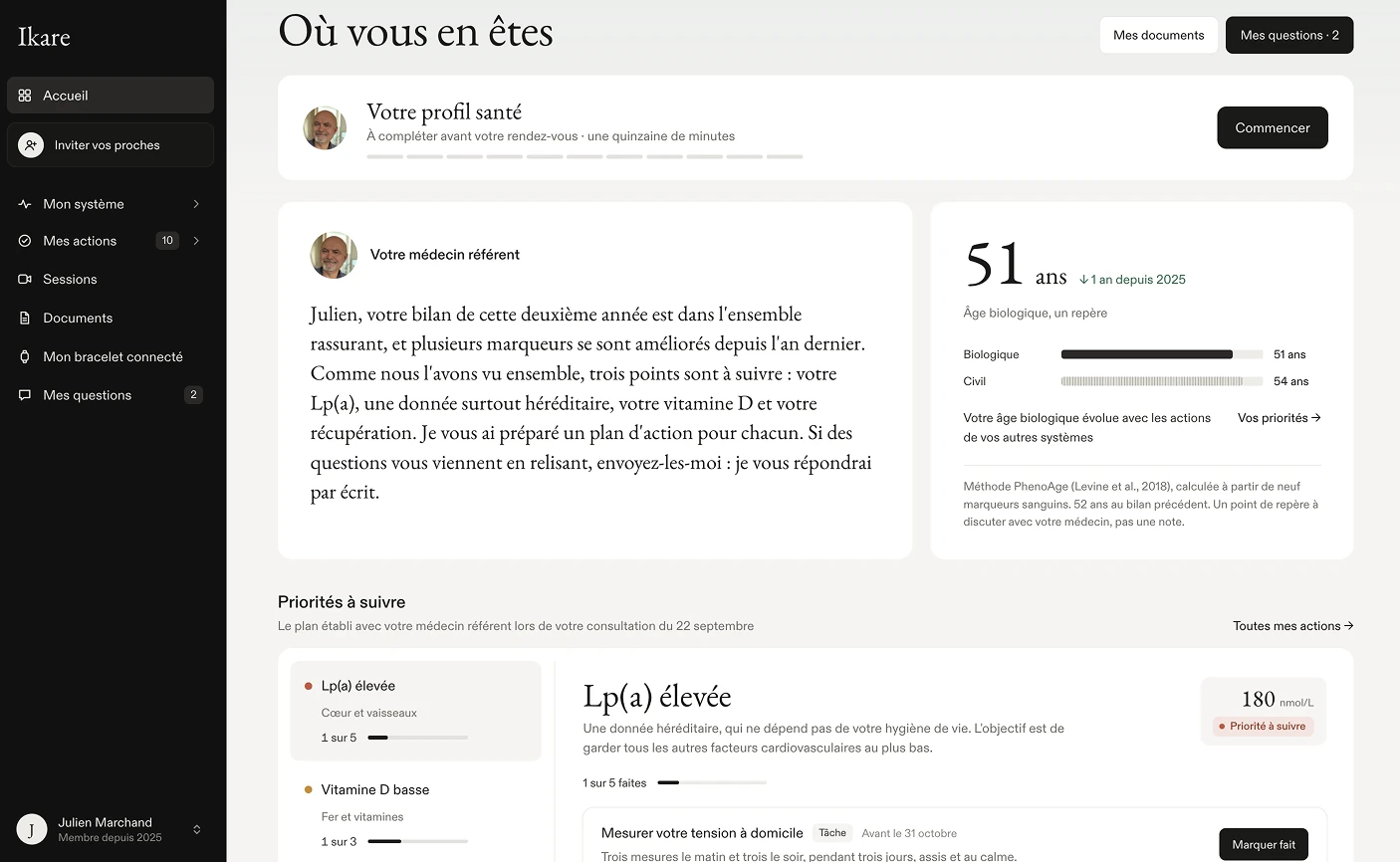
A biological age only makes sense as a trend. The Ikare protocol is therefore built around two points in time: a baseline measured at your home, then a second series of tests that shows whether your body has changed.
The first blood draw
The kit is shipped to your home. A nurse comes by in the morning, at home or at the office, and draws what is needed to calculate your biological age.
Reading the results
About a month later, your dedicated doctor goes over each indicator on a video call and explains what weighs most in your case.
The monthly adjustment
Your plan evolves from one month to the next. Between check-ins, the medical team answers your questions by message.
The sixth-month check
A second at-home blood draw verifies that the biomarkers are moving in the right direction. Your doctor adjusts the next steps with you.
The twelfth-month recalculation
The same tests are repeated and compared with the first. It is the gap between the two measurements that counts, not the single number.
Leave your contact details: we’ll call you back to talk about calculating biological age. Free, no commitment.
How does Ikare calculate and use biological age?
Ikare calculates your biological age with the PhenoAge method, from nine biomarkers in your blood test. A doctor registered with the French Medical Council explains it to you, places it in the context of more than 90 biomarkers, and recalculates it after six months to measure the change.
| Online biological age test | Ikare | |
|---|---|---|
| Method | Questionnaire or saliva kit | PhenoAge, based on nine blood biomarkers |
| Sample | None, or saliva sent by mail | Blood draw by a nurse, at home |
| Interpretation | A number and an automated report | A doctor registered with the French Medical Council, on a video call |
| Explanation of the gap | Rarely | Biomarker by biomarker |
| Context | The number alone | 90+ biomarkers, seven tests, sleep and activity |
| Next steps | None | Action plan, monthly coaching |
| New measurement | By buying another test | Included at six months |
Our advantages
- A published, readable method. PhenoAge relies on routine tests, each of which has a medical meaning.
- A doctor to explain it. They tell you what is pulling your biological age up or down, and whether a recent infection may have skewed it.
- One number among others. Biological age summarizes; the 90 biomarkers, strength, blood pressure and sleep give the detail.
- A trend, not a snapshot. The second blood draw, in the sixth month, shows the direction.
- No promise to make you younger. We use this number to motivate and guide, not to sell years.
Curious about the calculation? The guide breaks it down.
PhenoAge, epigenetic tests, questionnaires: what each method really measures, and why a single number is never enough. Free, by email.

Your biological age, explained by a doctor.
We would be delighted to talk with you and answer your questions. By phone or on WhatsApp:
+33 7 66 72 57 31Let’s talk about your health.
Leave us your contact details: a member of the Ikare team calls you back at the time that suits you.
Book a free call Chat on WhatsAppFree, no commitment.
Sources
- Levine ME et al. An epigenetic biomarker of aging for lifespan and healthspan. Aging, 2018. doi.org/10.18632/aging.101414
- Horvath S. DNA methylation age of human tissues and cell types. Genome Biology, 2013. doi.org/10.1186/gb-2013-14-10-r115
- Belsky DW et al. DunedinPACE, a DNA methylation biomarker of the pace of aging. eLife, 2022. doi.org/10.7554/eLife.73420
- Liu Z et al. A new aging measure captures morbidity and mortality risk across diverse subpopulations from NHANES IV. PLOS Medicine, 2018. doi.org/10.1371/journal.pmed.1002718
This guide is general information. It replaces neither a consultation nor the advice of your primary care doctor. In an emergency, call 15 or 112.
Further reading
- Zoī review: the Zoī clinic in Paris, check-up prices
- Lucis review: prices, check-up and customer reviews
- Healthspan: living long in good health
- Biohacking: what works, what is useless
- Reading your blood test: abbreviations and reference ranges
- Complete blood panel: list of tests, prices, fasting
- Longevity clinics: what they offer
- The 90+ biomarkers of the Ikare check-up